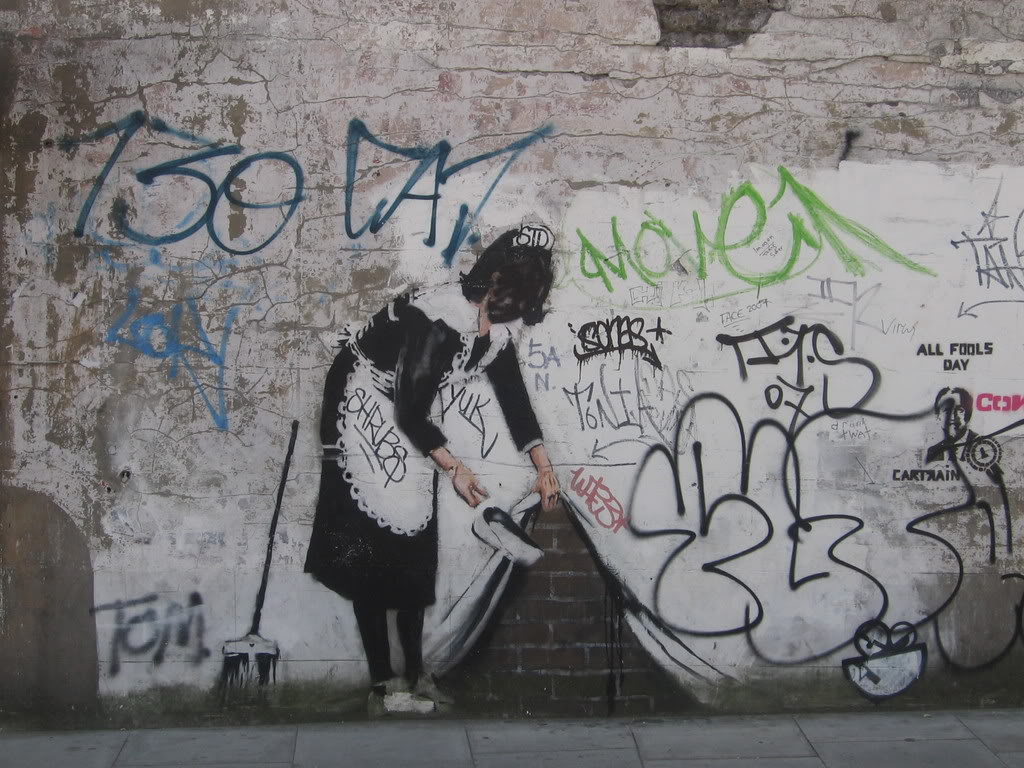
graffiti is often credited with being spawned from urban sprawl & popularised in the 70s political meets gang "pioneering" movement which traversed the city of new york spilling out into its streets & subways.
but this is not the case at all. like almost everything in this alleged fifth age of the sun, our history is that of reinvention. the desire & ability to make a mark, artistically impress, juxtapose or tag our environment has roots steeped in the very origins of humankind. ancient tribal mementos still stain paths of ochre in caves from humanity's earliest days.
so called higher & lower forms of art wedged into close association with those who have come before & after sharing the same canvas. it is refreshing to embrace the space & take the art back from whence it once came.
there are pros & cons to having more space on a dance floor. either results in entirely different forms of experimental expressionism. but more elbow room is wonderful. a different rhythm is afforded when there's room to groove. and fresh air/canvas to breathe.
i follow craig bunker AKA
bunkwaa, beloved graffiti artist, preferred alien & lightbearer of laughter. his icons are ubiquitous in the inner west scape of sydney & adelaide too but today his creatures are way out of town on a new-found quest. it is the beginning. the place of doors. we're not on google maps now dorothy.
the objective according to bunkwaa: is making the familar unfamilar, playing with the environment. reacting & responding to it.
nature versus nurture. escape from the hedonism of jungles urban. reverted expansionism starts here, graffiti style.
the bunkwaa characters are erroneous entities that dwell in the hidden folds of this dimension. they live off the energy that comes from human emotions & desires. in a forest once we leave, do they even still exist. or will they self-sustain & take-over?
this little guy obviously belongs here.
there's limited documentation of other current artists working with natural scapes although i've really been enjoying the work of
erik myxa [halitov] a siberian graffiti artist whose work is really inspiring if not somewhat upscale.
copyright: erik myxa [halitov] - the freedom series
copyright: erik myxa [halitov] ЗИМА series
russia actually has a really cool scene. not since
christo and jeanne-claude have i seen such awesome, fun & ultimately subversive environmental based works of art.
christo & jeanne claude [the christos] were popular heroes in my youth. i pinned their work on my walls & fell in love with their politicized artworks which ran amok over world landscapes.
viewed by millions of people, the umbrella series segregated & unified perception throughout continents where the work was featured in blue [japan] and yellow [USA] & enabled people to interact beyond their vehicle with not just the installations but the social, cultural and physical restrictions which typified the bureaucratic functions which they sought to illustrate metaphorically. one had to travel not just emotionally to engage with their works.
who is to say which is the alien? the motifs, the man, or the environment...